I have a routine at the beginning of each IT lesson to always have my laptop connected to the interactive whiteboard, data projector and internet whether I plan to use them or not. There have been many instances when we have been discussing something as a class where we have wondered about an issue or an idea and then quickly googled it or gone to Visual Thesaurus Googlemaps or Wikipedia to check something out immediately.
The other day we were just about to start our class when the students noticed the Skype icon pop up as one of my Skype friends logged in and naturally being curious they asked what it was.
Well I couldn't resist, so out the door went the lesson plan and in came a quick lesson on Skype. A minute or so later we were Skypeing with Chris Betcher and his daughter over in Canada. Chris had his webcam on so that added another excitement for the kids as they could see as well as hear Chris and Kate. It was fantastic and we had other teachers come into the room to see what was going on.
Chris has blogged about this as well on his blog. The wonderful thing as Chris said was that it took no time and was a really powerful opportunity to make links across the world. What I saw was total engagement, every student was totally engrossed. Many went home and checked out Skype for themselves. But I think the best thing was the chance to talk to Chris and Kate about their experiences in Canada and the opportunity for us to spontaneously (if only virtually) spread our wings into the big wide world. It's certainly something we will do again. In fact we are already planning another skype opportunity with some students in Phoenix, Arizona.
Friday, November 10, 2006


Wednesday, November 08, 2006
Thinking about where to next with IT
This year has been my first year of teaching a Year 7 and a Year 8 class for Information Technology. As a primary trained teacher who hasn't been fulltime in the classroom for the last 5 years it was exciting yet challenging at the same time. Particularly as I had to rethink my ideas about assessment, class structure, class management etc.
For example, as primary teacher I am used to having extended blocks of time where as a class we could go off on a tangent or run with an idea that the students have come up with, or explore something deeply and make up for lost time later. The absolutely most frustrating thing I found about teaching secondary students was the time limit. 48 minutes periods in an IT class is a ridiculously short amount of time to ensure that we had the time to talk and think and learn before getting to the computers. And of course the kids always wanted to get to the computers straight away.
It also meant that the end of lessons were often chaotic with shouts of SAVE your work as they were rushing out the door to the next class. This was instead of the lovely "okay everyone lets come together and think and talk about what we have learnt today" that I was used to as a primary teacher.
Teaching older students also came with the delightful "why do we have to do this" "this is boring" responses- not that I didn't get that as a primary teacher although I did mainly teach elementary students so it was rarer.
Having said that though I was somewhat surprised sometimes as I really tried hard to provide some (what I thought) were pretty stimulating lessons and activities.
But that's okay, it just challenges me more.
I actually did a survey with the kids last week and asked them things like what did they enjoy the most, what did they least enjoy, was there anything I could have done better, did they understand my instructions, was I approachable when they had difficulties.
On the whole the comments were very positive. But one interesting thing was that almost all kids said they hated blogging and they loved creating their digital portfolios.
So that got me thinking that maybe what I should do is think more about using wikis as a way to have the kids document more of what they are thinking (blogging) but make it more possible to express themselves like they like to do in their digital portfolios.
The Cool Cat teacher blog has some great ideas for ways to use wikis that I think I might try.
I'm thinking that this might be the way to kill two birds with one stone....maybe.
For example, as primary teacher I am used to having extended blocks of time where as a class we could go off on a tangent or run with an idea that the students have come up with, or explore something deeply and make up for lost time later. The absolutely most frustrating thing I found about teaching secondary students was the time limit. 48 minutes periods in an IT class is a ridiculously short amount of time to ensure that we had the time to talk and think and learn before getting to the computers. And of course the kids always wanted to get to the computers straight away.
It also meant that the end of lessons were often chaotic with shouts of SAVE your work as they were rushing out the door to the next class. This was instead of the lovely "okay everyone lets come together and think and talk about what we have learnt today" that I was used to as a primary teacher.
Teaching older students also came with the delightful "why do we have to do this" "this is boring" responses- not that I didn't get that as a primary teacher although I did mainly teach elementary students so it was rarer.
Having said that though I was somewhat surprised sometimes as I really tried hard to provide some (what I thought) were pretty stimulating lessons and activities.
But that's okay, it just challenges me more.
I actually did a survey with the kids last week and asked them things like what did they enjoy the most, what did they least enjoy, was there anything I could have done better, did they understand my instructions, was I approachable when they had difficulties.
On the whole the comments were very positive. But one interesting thing was that almost all kids said they hated blogging and they loved creating their digital portfolios.
So that got me thinking that maybe what I should do is think more about using wikis as a way to have the kids document more of what they are thinking (blogging) but make it more possible to express themselves like they like to do in their digital portfolios.
The Cool Cat teacher blog has some great ideas for ways to use wikis that I think I might try.
I'm thinking that this might be the way to kill two birds with one stone....maybe.
What did they learn?
The final task that the students had to do was to think of three reasons why they think that one person could change the world and three reasons why they think someone couldn't and then to decide for themselves.
Some coped with it well and others found it extremely difficult to think from another point of view and give both sides to an argument. With more time it would have been great to have a socratic discussion but with only one period it's difficult to find the time.
It's something more to think about and something that I would like to try again with another group of students.
Some coped with it well and others found it extremely difficult to think from another point of view and give both sides to an argument. With more time it would have been great to have a socratic discussion but with only one period it's difficult to find the time.
It's something more to think about and something that I would like to try again with another group of students.
Monday, October 23, 2006
How did we go?
The key to making this lesson work has been finding something that the kids can relate to. About 3/4's of the kids loved the Punk Rocker song and some turned their nose up but that was fine. It still worked as a way to get conversation happening.
I ended up using three different videos that I downloaded from YouTube- all related to the Free Hugs phenomonem. One was the original video by the Sick Puppies, one was a video created by a student in America and the third one was of a young girl in Canada who talked to the camera about the effect the video had on her and what she then did. It was a lovely reflective piece that summed up the power of the connections that can be made across the world.
I used a cool piece of freeware FLV to download each of the videos onto my laptop so that I could use them off line and also because we block Youtube here at school.
The lesson has actually blown out to three lessons because there was so much discussion and the kids wanted to hear the song and see the video a few more times.
Today we did our group thing, took the kids outside in the beautiful sunshine. They worked in groups of three and compared and contrasted the way each media-video and audio got it's message across.
Then after even more discussion and sharing we are almost ready to individually blog. It has certainly taken alot longer than I thought but the results have been really positive and have encouraged me to continue to use what is available to stimulate and encourage.
I ended up using three different videos that I downloaded from YouTube- all related to the Free Hugs phenomonem. One was the original video by the Sick Puppies, one was a video created by a student in America and the third one was of a young girl in Canada who talked to the camera about the effect the video had on her and what she then did. It was a lovely reflective piece that summed up the power of the connections that can be made across the world.
I used a cool piece of freeware FLV to download each of the videos onto my laptop so that I could use them off line and also because we block Youtube here at school.
The lesson has actually blown out to three lessons because there was so much discussion and the kids wanted to hear the song and see the video a few more times.
Today we did our group thing, took the kids outside in the beautiful sunshine. They worked in groups of three and compared and contrasted the way each media-video and audio got it's message across.
Then after even more discussion and sharing we are almost ready to individually blog. It has certainly taken alot longer than I thought but the results have been really positive and have encouraged me to continue to use what is available to stimulate and encourage.
Wednesday, October 18, 2006
Going to try this idea tomorrow
As a result of an oz teachers post that mentioned a really cool little video on Youtube called Free Hugs, I decided that I would try to use the video as a way to have students think some more about the way the internet and Web 2.0 is changing the world-or is it?
So what I have done is downloaded the videos using a great little add on in Firefox called FLV download which enables the videos to be loaded onto my computer. (Youtube is blocked at school so I can't make a direct link) and then I'm going to use Sandy Thom's song, "I wish I was a punk rocker" to get them to think about the different ways that one person might change the world. I bought it the other day on Itunes so hopefully I'm fine with using it.
The question is Can one person change the world?
For these students I have been using a blog - Wedderburn 7/8 Blog to write up my lessons and here's the post. I find it's a good way to keep a record for myself and also hopefully gives kids a chance to think a little more about what they have to do.
I think the addition of music will also help. We generally have music going in the classroom when we are working anyway although I'm guessing some will love and others will hate the Punk Rocker song. I think I'll try to find the lyrics to the song as well as that will add another level of understanding.
will report back tomorrow on how it went.
So what I have done is downloaded the videos using a great little add on in Firefox called FLV download which enables the videos to be loaded onto my computer. (Youtube is blocked at school so I can't make a direct link) and then I'm going to use Sandy Thom's song, "I wish I was a punk rocker" to get them to think about the different ways that one person might change the world. I bought it the other day on Itunes so hopefully I'm fine with using it.
The question is Can one person change the world?
For these students I have been using a blog - Wedderburn 7/8 Blog to write up my lessons and here's the post. I find it's a good way to keep a record for myself and also hopefully gives kids a chance to think a little more about what they have to do.
I think the addition of music will also help. We generally have music going in the classroom when we are working anyway although I'm guessing some will love and others will hate the Punk Rocker song. I think I'll try to find the lyrics to the song as well as that will add another level of understanding.
will report back tomorrow on how it went.
Tuesday, October 17, 2006
Back to reality
Well I'm back in Wedderburn after a really hectic but exciting week with my new Intel friends who are now going to train Participant teachers back in their schools in the Intel Online thinking tools.
After school this afternoon we met for our staff meeting and I presented the Knowledge bank case study work that we had done.
We also discussed changes that our prinicipal has been informed of through his regular regional meetings. Changes and expectations of the way schools will be using the internet within the next two years. A rollout of a Victorian Ultranet that all schools will access and use as their online portal for all curriculum, assessment and communication needs. Very interesting and exciting but it would be good to think that the states are talking to each other because I was only just reading a post in oz teachers from Andrew Dalgliesh, Manager of The Learning Place Online Learning Operations Branch, Education Queensland.
His post referred to an ongoing discussion about the advent of Web 2.0 applications and their effect on schools and education in general.
From his point of view he was discussing at a system level, the type of thinking and planning that must go into the development of an 'in house' portal for schools.
He says:
as Web 2.0 means more and more content going into so-called "personal" spaces where it potentially sits alongside "dodgy content", I think this will raise the issue of much of it being filtered out by current technologies and policies. Maybe providers like YouTube will need to develop reliable rating schemes that apply to their users rather than items of content (eg "KidSafe Publisher Level 2"?) so that safe content doesn't get blocked along with the bathwater?
As for in house e-learning environments, you'll be glad to know we are planning to redevelop the Learning Place as far as possible along web 2.0 principles, including:
* better integration of different application environments (eg LMS and resource repository)
* single sign-on (within LP and eventually to all inhouse environments)
* brokerage of content beyond the LP environment using trust relationships
* the ability for users to customise and aggregate their own environments
* incorporating new content types and technologies into a mainstream environment
* integrated search for maximum discoverability of resources
As well as:
* more seamless integration with systemic environments (the MOE)
* better Help support on the site (which we've done - see below)
* content caching to alleviate some of the bandwidth issues facing many of our schools
* investigating how we can broker content and services with outside entities based on trust relationships, so that users can exchange with others outside the system without compromising student safety.
The student safety issue is one aspect, but other considerations include the need to manage digital rights appropriately, scaleability and managing the operationlising of emerging technologies (even if they are only "emerging" in the education space - eg VOIP). Web 2.0 tends to be easier to achieve when you are running a single application environment (eg Moodle) on its own, but when you are running several and have a lot of critical services dependent on those, redevelopment takes a bit longer, but we are working on it.
As a systemic solution we also need to be careful balancing the needs of those on the cutting edge with the need to make a difference for those who are yet to engage with simpler technologies and the role of good web and tool design to support that process. It also has to work in with the larger Departmental strategic agenda (Smart Classrooms) and of course any feedback will be welcome.
In the meantime, you'll be glad to know we've rebuilt our Help section to provide more supportive information that reflects not only the most common queries we get but also the integrated approach we take to our different environments. This is the first example of a move for us to divide up the experience, not so much by the tools you use, but by the things you are trying to do.
It seems to me that we are all in a sense trying to do the same thing-wouldn't it be great if the generosity of spirit that has grown around the advent of Web 2.0 extended to each Australian state education department.
After school this afternoon we met for our staff meeting and I presented the Knowledge bank case study work that we had done.
We also discussed changes that our prinicipal has been informed of through his regular regional meetings. Changes and expectations of the way schools will be using the internet within the next two years. A rollout of a Victorian Ultranet that all schools will access and use as their online portal for all curriculum, assessment and communication needs. Very interesting and exciting but it would be good to think that the states are talking to each other because I was only just reading a post in oz teachers from Andrew Dalgliesh, Manager of The Learning Place Online Learning Operations Branch, Education Queensland.
His post referred to an ongoing discussion about the advent of Web 2.0 applications and their effect on schools and education in general.
From his point of view he was discussing at a system level, the type of thinking and planning that must go into the development of an 'in house' portal for schools.
He says:
as Web 2.0 means more and more content going into so-called "personal" spaces where it potentially sits alongside "dodgy content", I think this will raise the issue of much of it being filtered out by current technologies and policies. Maybe providers like YouTube will need to develop reliable rating schemes that apply to their users rather than items of content (eg "KidSafe Publisher Level 2"?) so that safe content doesn't get blocked along with the bathwater?
As for in house e-learning environments, you'll be glad to know we are planning to redevelop the Learning Place as far as possible along web 2.0 principles, including:
* better integration of different application environments (eg LMS and resource repository)
* single sign-on (within LP and eventually to all inhouse environments)
* brokerage of content beyond the LP environment using trust relationships
* the ability for users to customise and aggregate their own environments
* incorporating new content types and technologies into a mainstream environment
* integrated search for maximum discoverability of resources
As well as:
* more seamless integration with systemic environments (the MOE)
* better Help support on the site (which we've done - see below)
* content caching to alleviate some of the bandwidth issues facing many of our schools
* investigating how we can broker content and services with outside entities based on trust relationships, so that users can exchange with others outside the system without compromising student safety.
The student safety issue is one aspect, but other considerations include the need to manage digital rights appropriately, scaleability and managing the operationlising of emerging technologies (even if they are only "emerging" in the education space - eg VOIP). Web 2.0 tends to be easier to achieve when you are running a single application environment (eg Moodle) on its own, but when you are running several and have a lot of critical services dependent on those, redevelopment takes a bit longer, but we are working on it.
As a systemic solution we also need to be careful balancing the needs of those on the cutting edge with the need to make a difference for those who are yet to engage with simpler technologies and the role of good web and tool design to support that process. It also has to work in with the larger Departmental strategic agenda (Smart Classrooms) and of course any feedback will be welcome.
In the meantime, you'll be glad to know we've rebuilt our Help section to provide more supportive information that reflects not only the most common queries we get but also the integrated approach we take to our different environments. This is the first example of a move for us to divide up the experience, not so much by the tools you use, but by the things you are trying to do.
It seems to me that we are all in a sense trying to do the same thing-wouldn't it be great if the generosity of spirit that has grown around the advent of Web 2.0 extended to each Australian state education department.
Wednesday, October 11, 2006
Telling our story-The Minibeast unit
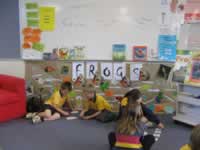
This week while in Sydney training a new group of Master Trainers in the Intel Program Teach Thinking with Technology I will also be participating in the Victorian Dept of Education Knowledge Bank Online Elluminate conference.
So on the morning of October 12th at 9.00 am I'll be sitting at a laptop with headphone and mic in a room in Sydney sharing our story of integrating and developing teachers using ICT and higher order thinking with teachers from Victoria and all over Australia and beyond.
I plan to take the participants on a virtual journey to illustrate the way two teachers and their students used technology and higher order thinking skills to wonder about the life and value of the minibeasts of our world.
Along the way we will use new technologies such a wikis, blogs, podcasts and online video.
I hope you enjoy it.
Subscribe to:
Posts (Atom)
 Flickr/annieb3525
 Facebook/Anne Baird
 Twitter/annieb3525
 Del.icio.us/annieb3525
 GMail/Anne Baird
 coComment/annieb3525
 Technorati/annieb3525
 TeachingwithTechnology/annieb3525


 Posts
Posts

