Monday, September 25, 2006

More Why Blogs

In reading a blog by Sheryl Nussbaum-Beach she touched on a subject that I have pondered for a while and made it so simple-and perhaps that's the beauty and the solution-make it simple.
I want my students to reflect more effectively and maybe it can be as simple as this?

Learning to Learn
The learning journal assignment is the most important tool in making that transition from learning to learning to learn. There are four big questions to be looking at:

1. What have I learned (today, this week, whenever)?

2. How did I learn it?

3. Could I have learned it better/differently?

4. How could I use what I've learned to benefit someone else. (In other words, could I teach/coach/help someone to learn more effectively based on my experience?)

Sunday, September 24, 2006

Our new podcasting venture

In the last couple of days of term I worked with our Tanya's Grade 2/3 students to help them voice record their reports that they had written about their frogs. They loved the experience and loved to hear their voice once we loaded it up on the web. It was really simple using audacity, an opensource software free download that records and edits sounds. we even used some copyright free music to add some background music to the recordings.
really cool and the kids loved it.
Next term I'm working with some students in Grade Three/Four and I can see that we are going to have a real opportunity to develop this idea further and perhaps create a real podcast with RSS feed and all.

Web 2.0 What is out there?

Bob Stumpel has put together a list of web 2.0 applications that seems to be growing by the minute. It 's worth thinking about how this will impact upon education and also how we as teachers can harness the development to engage and increase the learning of our students.

Friday, September 22, 2006

More thoughts about thinking tools

So what is the value of having thinking tools online vs the more traditional pen and paper, drawing, model?
Firstly having the tools online makes them accessible from any classroom or even location that has internet access. We have recently purchased a set of laptops that can be used with wireless connections anywhere in the school and this makes the availability of the thinking tools much more real and applicable simply because we can access them no matter where we are.
The engagement factor can't be underestimated. Students interact with each other online and in real time whether they are in the same classroom or in another school. Even the design and ease of use of the tools seems to engage then in a way that drawing with pen and paper doesn't.
Having said that though the tools are designed in a way to be simple and 'non' distracting so that the concentration is on the task and not the tool.
The tools are designed so that all can see the results-it allows for teachers and other students to review and observe.
The tools are generative-they can be reviewed and used again and again. They can be built upon and added to over time.
They are open-ended and not limited by content. I have used the tools with students in early years and middle years for science, for english, for integrated studies.
It's all about visually representing thinking and actively contructing ideas and meaning.

Wednesday, September 13, 2006

Questions about thinking tools

Last Friday, 8th Sept 06 I presented at the ALEA conference in Melbourne. It was held at the Australian Centre for the Moving Image ACMI at Federation Square. What an awesome venue and a great chance to see what the centre is all about as well as hear some inspiring speakers.
My session was entitled Thinking with Technology and I designed it to showcase some of the ways that I have been using the Intel Thinking Tools at Wedderburn College.
Basically I showed some examples of how the Visual Ranking, Seeing Reason and Showing Evidence tool can be used to display and visualise the thinking that is occurring as students are working through a problem or a challenge.
One of the questions that was raised during the session was interesting and one that I would like to explore a little more.
Basically it was something like, What are the advantages of doing something like this online? Why not just, for example rank things on cards or write them on a white board, why not just draw a concept map, why not record and categorise evidence on pen and paper?

Firstly, I think the bottom line is you firstly think about the outcomes that you want to achieve. If the purpose is to simply rank concepts and to discuss and justify why, then doing it with cards or on a whiteboard would work equally as well as doing it online.
I think the value that is added online is the fact that students can readily see the ranking of other students immediately. The process of reordering, discussing, rethinking and evaluating can be done quickly and responsively.
I think a great advantage to the teacher is that all the tasks can be stored and returned to easily and efficiently as well.
I would like to discuss this more and will do so over the next few days.

Thursday, September 07, 2006

Creating new learning and thinking with technology.

It's been a while since I posted and I actually have a few things in draft form that I want to post over the next couple of days.
The last couple of weeks have been hectic but exciting with the main focus being a week in Melbourne training the first Australian group of Intel Senior and Master Trainers in the pilot program Thinking with Technology.
It was a very challenging week both mentally and physically with very long days and nights keeping up with the program. But it was an incredibly rewarding week for me to work with other teachers from Victoria and Queensland who are exploring the use of technology and higher order thinking in the curriculum.
One thing that I found really valuable was to create a wiki specifically for this group so that they could reflect each day online. It meant then that they could comment on each other's thoughts and also meant that other interested people could read the comments from all over the world. So in a sense it was a pilot within a pilot and I think it worked very well.
Go here to check out what they said.
Intel Thinking with Technology Pilot

Saturday, August 26, 2006

Kids and Mini Beasts and Computers


What is it about kids and minibeasts? They absolutely love collecting them and observing them and probably squashing them. But I suspect over the last few weeks I think they have developed a more healthy respect for the little creatures.
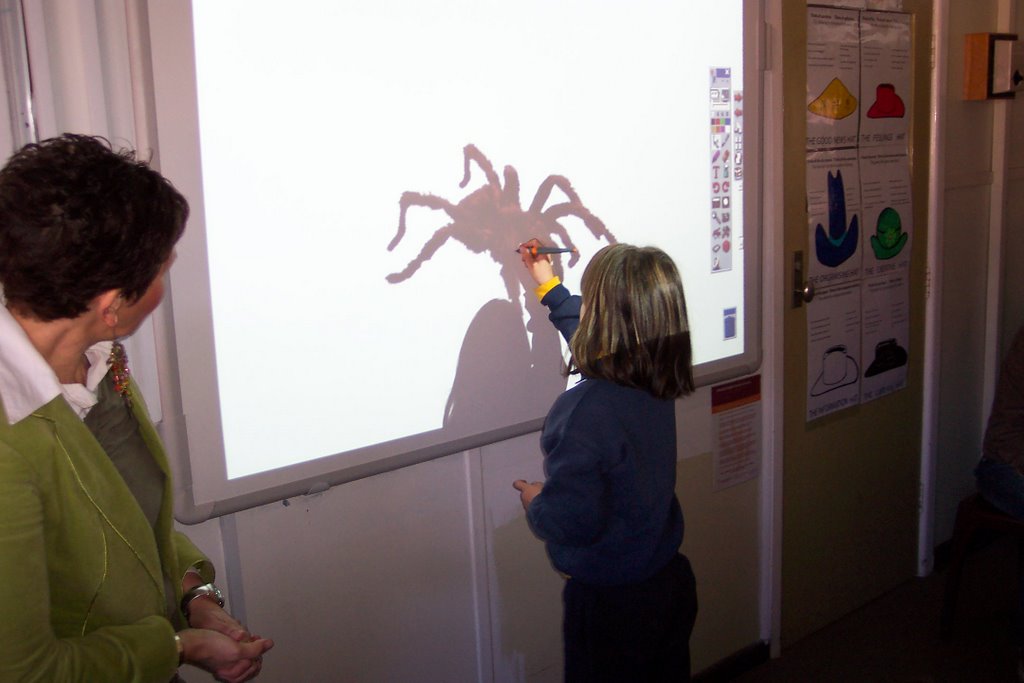
What is it about kids and computers? It's not the same thing I know but what is amazing and exciting is the way the kids become so engaged whenever we bring laptops into the classroom. We have been using the laptops over the last couple of weeks on Tuesdays to allow the kids to create one of the tasks that was planned in the unit of work- creating a ppt to represent their understanding of a minibeast. These children haven't been exposed to MS Powerpoint and only in this second half of the year, virtually when we began the Minibeast unit, have they been given access to their own server and internet account at school. But in this short time they have learnt to log on, to save and name their work, to create a new PPT file, to add images and to copy and paste text into their presentations. Some have even learnt to narrate and record their writing onto the slides.
What amazes me I guess is the ease with which they pick up the skills and seem to be able to cope with this new learning with such ease and enthusiasm.
One of the most exciting things though is how willing the students are to help and be patient with each other to support their learning.
The challenge for me though is to ensure that the learning is really happening and that it's not 'busy' time. To that end Tanya employed some short cut strategies to ensure that the keyboarding challenge wouldn't hold the students back.
The students had researched their frog and discovered many aspects of their habitat and development. They then wrote these facts and ideas in the traditional manner by writing and editing in their storywriting books. Tanya, their teacher, then spend a short time after school one day and word processed each of their reports into a word document.
The day that they were to work on their PPT's the children then simply went to a shared folder and copied and pasted their particular piece of text onto the slides of their PPT thus saving that awful waste of very slow typing that very young children can only achieve.
It was just a matter of teaching them how to locate and paste some images from MS clip art and/or some of the free online images libraries such as Pics4Learning or Freefoto and then they had created a pretty effective PPT presentation. For these kids the bells and whistles of PPT are a big deal and as far as I'm concerned that's fine for a little while. They are having a ball discovering how things move and make sounds. But soon we'll also teach them about the less distracting ways of making an impact when you are sharing your learning.